Showing posts with label Ethiopia. Show all posts

Saturday, 10 October 2015

Falling in love with Konjo Habesha, our trip to Jimma

In August 2012, Konjo habesha and I embarked on a trip to Jimma, unknowingly at the time, this trip would change everything.  This is when I was to fall in love with him.  

Click here, to read how we first met.

In south-western Ethiopia lies Jimma, situated in the Kaffa region, according to history it is home to Kaldi and his goats, hence the birthplace of coffee (buna).


'Jimma the Origin of Coffee' Roundabout

I wanted to visit some of my Ethiopian friends whom I had met in my first trip in 2007 with Habitat For Humanity to Jimma, very beautiful people dear to my heart, the very people who endeared me to Ethiopia in the first place.  We were lucky to have the companionship of two robust habesha boys we befriended on one of our adventures (konjo habesha and I) in Megenenya (ampharic translation: meeting place), a bustling transport epicentre/sub-city in Addis Ababa.  


Scenes of bustling public transport hub Megenenya, meaning 'meeting place' -  a sub-city of Addis

Soon after, we became friendly with their family, especially their grandmother who was their main caregiver.  We told 'grandmother' our Jimma plans and asked her permission to take her two grandsons as our companions on our trip.  She gave us her blessings, probably happy with the prospect of having a quieter house and bewildered that we would want to take her two active grandsons with us to Jimma, a rough 300km away or 4-5hours on the road by car or 7-8hours on a public bus, south-west from Addis!  We thought it would be fun - the four of us, and it was!!!!  
R O A D  T R I P!!!!!!!


Left: Ethiopia map - Jimma lies south-west of the capital Addis Ababa
Right: The winding and undulating Addis-Jimma road

The Addis-Jimma road takes you on a visual feast from the highland of Addis Ababa slowly through Ethiopia's south-western plateau which reveals rich greenery, breath-taking views at times from jaw-dropping heights, with the all-too-occasional encounter with livestock and their famers along the way.  It's road sharing at it's finest!  


Left: Young herders with livestock on the Addis-Jimma road, a common sight
Right: Ethiopia's countryside of rich greenery and clusters of huts

Ethiopia's agricultural lifestyle is on full display as groups of isolated round thatched huts and livestock are a common sight.  Young cattle herders learn to contribute to their family's work by tending to their family's livestock from a young age, often seen carrying long sticks.


Our two active habesha companions: Kidus (glasses), Dagim (orange shirt)
Kidus, 10years old (at the time) is exuberant, social and stubborn.  A real hand-full!  Although he was deaf, this disability did not hinder him one little bit, it actually ENABLED him to use his other senses to the max!  He played hard and got into mischief like any other 10year old young boy.  

Dagim, 7years old (at the time) pocket-sized, wise and charismatic beyond his years.  He could talk the pants of anyone, even though talking the pants of anyone a common trait of the Ethiopian people, Duggam could find an argument to back up the most minuscule point.  I would often hear him and Yonas debating over some topic (a favourite Ethiopian pastime) and I loved to just listen to him talk, mesmerised by his wisdom and charm.  I often told Yonas that he would be the next prime minister of Ethiopia. 


Main pic: Jimma's bajaj's
Surrounding pics: Scenes from Jimma

I love Jimma.  It is a special place for me - the original buna (coffee) region of Ethiopia, hence the world, we had the time of our lives.  We dissected the town, discovering and adventuring on the local blue bajaj, bikes, the blue public taxi vans and by foot, visiting some of the boys family members and my dear Ethiopian friends.  


Reuniting with friends in Jimma after 3years

We enjoyed getting to know the boys better through countless conversations and day-to-day dealings, most of it good and then of course we experienced our obligatory "other moments" of looking after kids.  There was one interesting time, one of the boys had an all-consuming melt-down/tantrum which totally caught konjo habesha and myself off-guard, having NO IDEA how to calm him down IN PUBLIC and then behind closed doors, which quickly turned into two fighting brothers!  

Weyneeee!!!!! What did we get ourselves into?  


It was a crash course into what having children might be like and working together.  What a wonderful crazy beautiful time we all had together.  It was during this trip that I had a heart shift and started to see konjo habesha in this beautiful paternal light, a most illuminating yellow 'halo' light.  He would make a wonderful father I thought to myself. 

Jimma, now with more reason, continues to hold a special place in my heart as the region where I fell in love with Ethiopia AND with the man of my heart.


I fell in love with konjo habesha unsuspectingly and unexpectantly.  Just as the sun rises each day and the seasons change from spring to summer, from autumn to winter and back to spring again, my love developed so very naturally, with each season of our relationship, love growing and laying a meseret of friendship ripe for love to crystallise.  

Yene (My) Ethiopian Story

  • First trip to Ethiopia - Sept-Oct 2007 (five weeks)

Habitat for Humanity House Build in Jimma

“I’m going to Ethiopia to lead a team for Habitat for Humanity (HfH) to build mud houses for the local people” says Marty Van der Burg.  A builder and an Ethiopian heart-stung man.  After little coaxing I say “I’m in”.

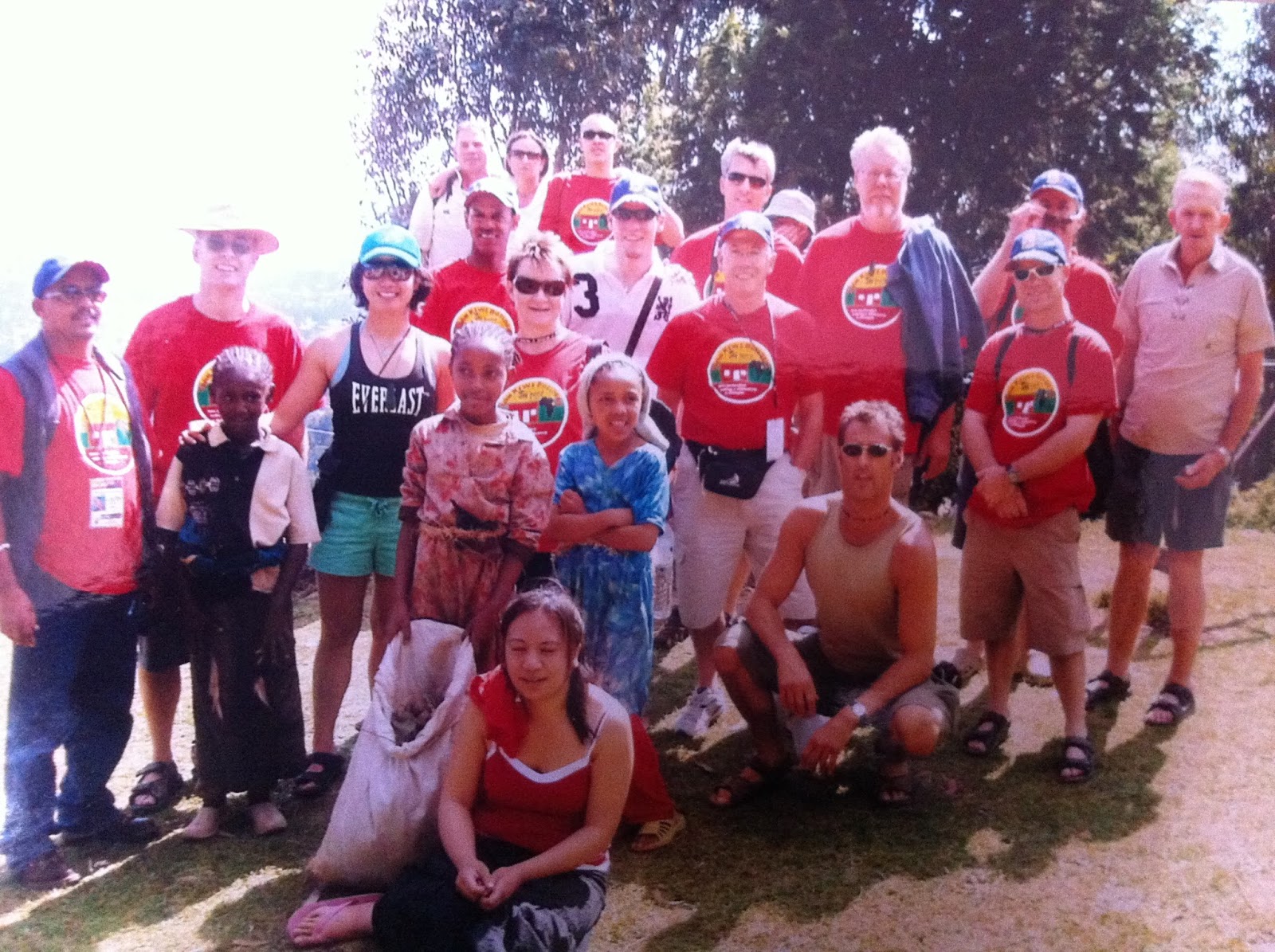
September 2007.  The inaugural New Zealand (NZ) Team Kiwi fly to Ethiopia under the HfH umbrella.  An oddball group of 18 “kiwis” of all ages, sizes and ethnic backgrounds.  


Team Kiwi 2007 (and a few Ethiopian children), Habitat for Humanity Ethiopia build

Clockwise from Left: Habitat for Humanity Ethiopia Mud house construction Jimma site; Team Kiwi member Kevin at the entrance of a house mid-construction; and me (Kim) practising my squatting skills at the bottom of a freshly dug-out to-be latrine pit.

Under the blaring Jimma sun we work with locals (and the local village children) to construct mud houses (chika bet-oche) in various stages for two weeks.  Each day we eat lunch in traditional Ethiopian fashion, with our hands, consisting of injera and various complementing food made by local women paid by us - team kiwi, and shared with all - young and old, chika bet contractors, villagers, house recipients and us - team kiwi.  

Left: Team kiwi at the building site having a coffee break;
Middle & right: Lunch time! Ethiopian chika bet constructors and Team Kiwi members tuck into lunch.

Each day for morning and afternoon tea we drink traditional Ethiopian coffee (buna) freshly roasted and prepared by one of the local women.  The smell is intoxicating and fills our senses with delight on a daily basis.  She delicately pours from a jabena (Ethiopian clay coffee pot) into small china cups, each sweetened with sugar, ranging between 1-3 teaspoons depending on the receivers preference, usually complemented with a snack of freshly popped and sweetened popcorn or roasted barley and peanuts.  Three cups of coffee are always offered at each setting.  

Coffee Coffee Coffee!!  From left to right: an Ethiopian woman pounding freshly roasted coffee in a mortar and pestle;
Me in traditional Ethiopian cotton clothing on coffee serving duty; coffee poured out from a jabena.


A captivating little village boy captures my heart.  His name is Fikadu (see photo below) and my guess is he was aged about 7-8 at the time, it is hard to estimate the age of Ethiopian children with the lack of optimal nutritional sustenance factoring in many cases resulting in sizes unparalleled with their ages.  Each day he finds me and assists me wherever I am working.  It’s hard not to make a heart connection with at least one of the village children, they are heart tuggers.  

Top from left-right: Fikadu and his brother Tamrat (Fikadu is the younger/darker one on the right); Fikadu and his family outside his house;
Bottom left-right: These are the rambunctious Ethiopian children in Jimma who greet us each morning at the building site; friends

I return to NZ changed - intrinsically, spiritually, emotionally; internally something happened.  From then on my heart started to beat for this beautiful east african country.


  • Second trip July-Oct 2009 (three months)


Volunteer English Teacher at English Alive Summer School in Nazret.


Collection of moments of students and teachers during my teaching season at English Alive School in Nazret in 2009.

After spending three months volunteer english teaching at English Alive summer school in Nazret from July-Sept 2009, I return to Addis to fly back to NZ.  What will turn out to be my last evening in Addis on this trip and possibly the most important day of my life.. I ride the elevator of KZ hotel on Bole road with who would be at the time - my future husband.  


KZ Hotel on Bole Road
A well-suited up Ethiopian man and the only other occupant in the elevator, who happened to be the hotel’s manager on duty, was possibly the most handsome man I had ever seen!  I couldn’t look away.. I was mesmerised.  “Konjo Habesha” I said.  Translation: Beautiful Ethiopian.  

I have been known to lavish my appreciation of beautiful Ethiopians on them, male or female - they are all aesthetically stunning, and this time was no different from any other.  A half smile was given in return and not much else.  And that was that.


Konjo habesha in his suit


  • Third trip - 2011-2012 (one year)

Elephant Walk Cafe on Bole Rd (exterior and interior)

Fast forward to one fine Addis Ababan day in Easter April 2012, around midday I walk into The Elephant Walk cafe on Bole rd.  “Are you Kim?” a bewildered Ethiopian man seated at an outside table with a lady friend questioned.  It was the Konjo Habesha looking a little older but still konjo.  “Yes” I replied, not recognising him at first until I walked closer and had a better look at his face.  

Talk about lifes' synchronocities!  There are four million residents in Addis Ababa and the universe places this man in my path twice in two consecutive trips four years apart … and to top it off he still remembered my face!  


Bole Road - a bustling arterial road in Addis Ababa

We were like magnets drawn to each other by a larger force.  It also seemed the universe was adamant our courtship be hosted by Bole Rd in Addis Ababa, Ethiopia.  We exchanged numbers.  And that was that.

From Left to right: Macchiato and Cake at Saay Pastry on Bole Road; Taitu hotel exterior; and interior

We meet up for macchiato and cake a week later at Saay Pastry cafe on ….Bole road (you guessed it!).  We make plans to meet up later that week on Thursday at Taitu Hotel, one of my most favourite places in Addis to chill, in crazy-wonderful Piassa, where I was staying and later in the evening to head to Jazzamba, situated in Taitu Hotel’s compound, for some tantalising soul-energising live, old-skool, big band Ethio-jazz music.  And so we do.  

We have a fine time enjoying pizza, listening to live Ethio-jazz music, dim yet invigorating ambiance, an impromptu ampharic lesson given by Konjo habesha under the influence of two bottles of very sweet local Axumite wine and then we head to my room for the night.  And that was that.

Jazzamba vibes


"Ambassel" by Addis Acoustic Project live at Jazzamba, Addis Ababa,

Konjo habesha

Konjo habesha is respectful, sweet and calm.  He vibes off a peaceful harmonious homeostatic energy and takes everything in his stride with a contented disposition firmly rooted in the present.  A beautiful, pure, untainted soul.  

Kim (me)

I am a dream-lover, a treasure-hunter, a soul-seeker driven by visions and goals, forever blowing in the wind, changing and redirecting in rhythm with the whisperings and stirrings of my heart and soul.  A wild card.  Unpredictable, complicated and spontaneous.  My energy rooted in ideas and possibilities - abundant and overflowing.


Yin and Yang symbol


We are polar opposites.

Like night and day.

Like yin and yang.

Like faranje (foreigner) and habesha (Ethiopian).

Needless to say our energies clashed or balanced, however which way you looked at it, or however which way WE looked at it.  


During our courtship I pushed Yonas away numerous times feeling frustrated and underwhelmed by his energy.  We continued this way on and off for months, blurred lines - friends and occasional lovers.  Most importantly during this time Yonas, despite our tumultuous relationship, continued to support me by coming and supporting me in my dance endeavours.  

Little did I know at the time I was becoming to appreciate him emotionally.  His presence, not needed but felt and cherished.  His love, strong yet boldly humble, helped build a strong foundation (meseret) of friendship between us.


"Kass pa kass enkolal begrua tehidaletch"
Slowly slowly the egg learns to walk.

Amharic translation: things take time.

Ethiopian proverb


Click here, to follow our story of how I fell in love with konjo habesha on our trip to Jimma.


Wednesday, 23 September 2015

Contentment

It's a crisp Saturday night in Addis Ababa, I'm sitting across from my *Habesha in Avanti, a plush Italian restaurant near Bole Bridge, sipping on red wine and having just ordered dessert.  My tummy feels contentedness and my heart bursting at it's seams.

I look deep into my Habesha's beautiful big brown eyes, feeling stupidly happy and wonder-FULL and spontaneously blurt out for the first time in my 31 years of life "I feel content". 


My Habesha (Ethiopian)


Alongside the fact I was living in Ethiopia, a country that I loveI was lucky enough to keep up my passion of dance through - teaching Zumbabreakdancing (b-girlingand writing monthly dance articles for an Ethiopian magazine.  I had acquired my own humble abode in a quaint one-bedroom guesthouse adjoined to an Ethiopian family's house in their tiny compound in Gerji Subcity - a family I thoroughly enjoyed the company of and with whom I enjoyed the simplicities of everyday Ethiopian life such as drinking *buna 2-3 times daily, practising my amharic and even Eskista dancing! Also giving me immense pleasure was riding the blue public taxi-vans around Addis, meeting like-minded people everyday in beautiful serotonin-giving sunshine-filled days.  


was not making near enough money in my Zumba work to make ends meet yet my heart and soul felt a deep profound peace I had never experienced before.  


Ethiopia has So. Much. Beauty.


I feel extremely blessed and fortunate to have found my spiritual home in Ethiopia and cultured a life that feeds my soul and nurtures my spirit.  

I wait in hungry anticipation of returning next year in 2016 to resume my Ethiopian journey.


What feeds your soul?   


*Habesha = the name given to Ethiopian locals in Amharic (the national Ethiopian language)
*buna = coffee in amharic

Living with Maza - my Ethiopian mother

Maza (my ethiopian 'mother'): A strong Ethiopian woman, the matriarch of her family of two daughters and husband.  

Short, staunch and always with a mischievous twinkle in her eye is how you will find her.  An endearing character who can talk your ears off (an ethiopian characteristic), infectious humour and laugh, smart (turned one part of her house into an adjoining guesthouse which gives the family decent consistent money to live off), an educated woman with good english.  I miss her wisdom, wit and charming character.  

I have so many fond memories of this woman!! 


Maza

"Keeeem!!"  The daily endearing cry of Maza calling out my name, usually to drink *buna with her.  

For nine months in 2012, I lived in a quaint guesthouse adjoined to Maza and her family's main house in their tiny compound containing a small front porch and outside kitchen in Gerji - a subcity in Addis Ababa (the capital city of Ethiopia). 

Maza and her family
top left-right: Seble and Twaris

bottom left-right: Jonny and Maza

A good way to fully embrace the culture and local people, in this case Ethiopians, is to live in close proximity to the people; to hear amharic, to ride the public transport, to witness their blessings and struggles, to immerse in the deep-imbedded social ways and to get a good understanding of a functioning family.  
  • After Zumba some days I would buy meat from the butcher and Maza would cook us *tibs and we would gobble it up with freshly-made injera followed by buna.  I cherished those times with her.
Tibs and Injera
a traditional and delicious ethiopian meat dish
  • I remember when I was pregnant in my first trimester suffering from extreme nausea and heightened smell and the strong smell of cooked onions and *berbere that Maza and the girls never failed to cook everyday was nauseating...not just once in a while but every. single. day.  2-3 times daily!!
Our engagement - hosted by Maza and her family, Nov 2013.
From left to right: Myself, Jonny, Yonas and Maza


  • Our engagement at their house with Maza, Jonny, Twaris and Seble.  They graciously hosted us with traditional food and drinks.  Maza and the girls made this huge traditional round bread made for special occasions, appropriately named 'Diffo dabbo' meaning 'big bread' in amharic; all the traditional dishes for special occasions i.e doro wat (chicken stew), tibs (chunks of meat cooked in spices), vegetarian dishes and of course freshly homemade injera.  So much love went into this meal....Delicious!!!

Traditional Ethiopian food and drinks Maza and the girls prepared for our engagement

Video of me washing coffee beans with Maza and Twaris in the compound.

  • Maza taught me how to prepare and serve an Ethiopian coffee ceremony for my 31st birthday, right from buying the green beans at our local shop, cleaning, roasting, grinding to serving.  I practised preparing and serving many times before I was happy and ready for my big coffee-making debut.  Even now, while I await my return to Ethiopia whilst living in New Zealand, I prepare and serve Ethiopian coffee the traditional way for my husband and I every Saturday and Sunday.  It's my way of keeping in touch with the country I miss so dearly.
Collection of moments from my 31st birthday at my place in Maza's compound
top left-right: Cake!; Maza providing me moral support during my birthday coffee ceremony (I was extremely nervous because I wanted to get it just right!)
bottom left-right: serving coffee; traditional dress

  • Power would go out often and I would light a candle and have my dinner outside on the little concrete front porch that adjoined the main house and my place.  Sometimes the girls would join me and we would gossip and talk nonsense, under the moon and stars.
  • Practising my zumba tracks and dancing Eskista with Maza and the girls.  Learning Amharic.  Seble would help me translate popular Ethiopian songs that I loved into english so I could understand what they were singing about.  I particularly loved Fiorina by Teddy Afro and Helen Berhe.  

Twaris clearing hail from the front porch of the compound.

The energy in Maza and her family's compound was lively, spirited and affectionate and they lived simply in contentedness and humble abundance.  What a blessed human experience I had spending nine intimate months with them.  


*buna = coffee in amharic
*tibs = a traditional and popular meat dish
*berbere = spicy Ethiopian spice

ESKISTA - The shoulder-shaking traditional Ethiopian dance

Eskista means “dancing shoulders” and is performed with head, neck, chest and shoulders shaking in specific ways.  Dancers are dressed in traditional attire from the indigenous tribes of the Northern parts of Ethiopia i.e. Amhara, Wollo, Gondar etc. Today Eskista is still performed and has also manifested itself in modern culture such as the Harlem Shake and in Beyonce's video 'Who run the world (girls)'.  Eskista is one of the more popular dances synonymous with Ethiopia.

I lost my eskista-watching virginity in 2007 in a traditional Ethiopian restaurant in Addis Ababa (the capital city of Ethiopia) on my first visit to Ethiopia. 


Not a stranger to dance, this style of dance was so different to anything I had ever seen; powerful, animalistic, raw, exciting, visually heart-pounding and not to mention extremely hard to do!  Furthermore, the accompanying music transfixed me and transported me to my happy place, somewhere out in Africa's tribal wilderness; in this case Ethiopia's Amhara region.  I had never witnessed anything so sensually extraordinary.  


Ethnic regions of Ethiopia, Amhara region in light green
the region in which eskista has it's roots

As a dancer, for me, when I watch such powerful and unique dances such as Eskista, it makes me wonder of the origins.  How did it come to be?  What is the intention behind the movements and what ideas is the dance trying to convey? Which qualities of cultural history e.g heritage, events, environment, ancient stories, customs and rituals, religious beliefs, ideas, emotions and thoughts; interweave to manifest a particular style of dance?   

Ethiopia is a widely diverse country with over 80 different rich ethnic, customs, cultural and linguistic groups and over 150 unique dance movements across her regions.  The music and dances are dating 3000 years back in the African history. To delve into Ethiopia's dance ancestral lineage and evolution piques my curiosity.


Some of Eskista's influences are (and not limited to):
  • Orthodox Christian and Muslim motives play the role of shaping the culture and traditions of this ancient nation. 
  • Typical body movements performed mainly with the head and shoulders to express certain emotions and impressions from life dating back to the people of Ethiopia's Amhara tribe.
  • Relationships between genders, hence love songs; the variety of war songs, hunting songs, shepherd songs, and work songs all have a collective influence on Eskista's  movements.
  • There is one theory of how Eskista was inspired by snakes.  Ethiopian people often observed the movements/"dances" of the snake, the way they would shake their neck.  Additionally, it is said that the sound the rattlesnake produces when it shakes it's tail had an influence on Ethiopian music and the style of singing.
  • The music played during the dance is often produced with traditional Ethiopian instruments like krar, flute, drums and mesenko - which to some extent play an influence over the dance.

  • The different areas in Amhara i.e. Wollo, Gondar or Gojjam shows some variations on the dance.
  • Expressing religious rituals in the Ethiopian and Jewish deep cultural roots.

Eskista's manifestation in modern culture:


  • Beyonce - Who run the world (girls) video clip

At the beginning of superstar Beyonce's 'Who run the World (girls)" video she makes an Eskista-like dance, hands on her hips and shaking her shoulders, which looks unbearingly similar to the shoulder shaking of the Eskista.  

Beyonce visited Ethiopia in 2007 and performed a concert to bring in Ethiopia's New Millennium.  Who knows...perhaps she was inspired by the Eskista on her visit!  
Check it out for yourself Beyonce's Eskista Inspiration

  • The Harlem Shake
According to sources, the 'Harlem Shake' dance originating in 1981 in the streets of Harlem, New York, by a resident called "Al B" has it's foundation in the Eskista. Watch Harlem Shake


One of the best ways to experience the Eskista first-hand is at an Ethiopian wedding!  Everyone is in a celebratory mood, and everyone lets loose!!  Watch out as one-on-one spontaneous Eskista battles usually ensue and it's utterly enthralling.


Dance is a universal language and a wonderful medium of preserving heritage and culture that resonates with all generations.  The next time you get down for a boogie or participate in your weekly dance class, take a moment to think, what are the origins of this dance?


One will never fully apprehend the exact context to the evolution of the Eskista without the impossible realm of having paid witness to the ancient times to present.  One can hope to gain a firm grasp of Eskista's roots by visiting the Amhara region and talking to the people, elders in particular, and witnessing the culture firsthand; and/or by obtaining a deep understanding of the history and customs of the region.