- First trip to Ethiopia - Sept-Oct 2007 (five weeks)
Habitat for Humanity House Build in Jimma
“I’m going to Ethiopia to lead a team for Habitat for Humanity (HfH) to build mud houses for the local people” says Marty Van der Burg. A builder and an Ethiopian heart-stung man. After little coaxing I say “I’m in”.
September 2007. The inaugural New Zealand (NZ) Team Kiwi fly to Ethiopia under the HfH umbrella. An oddball group of 18 “kiwis” of all ages, sizes and ethnic backgrounds.
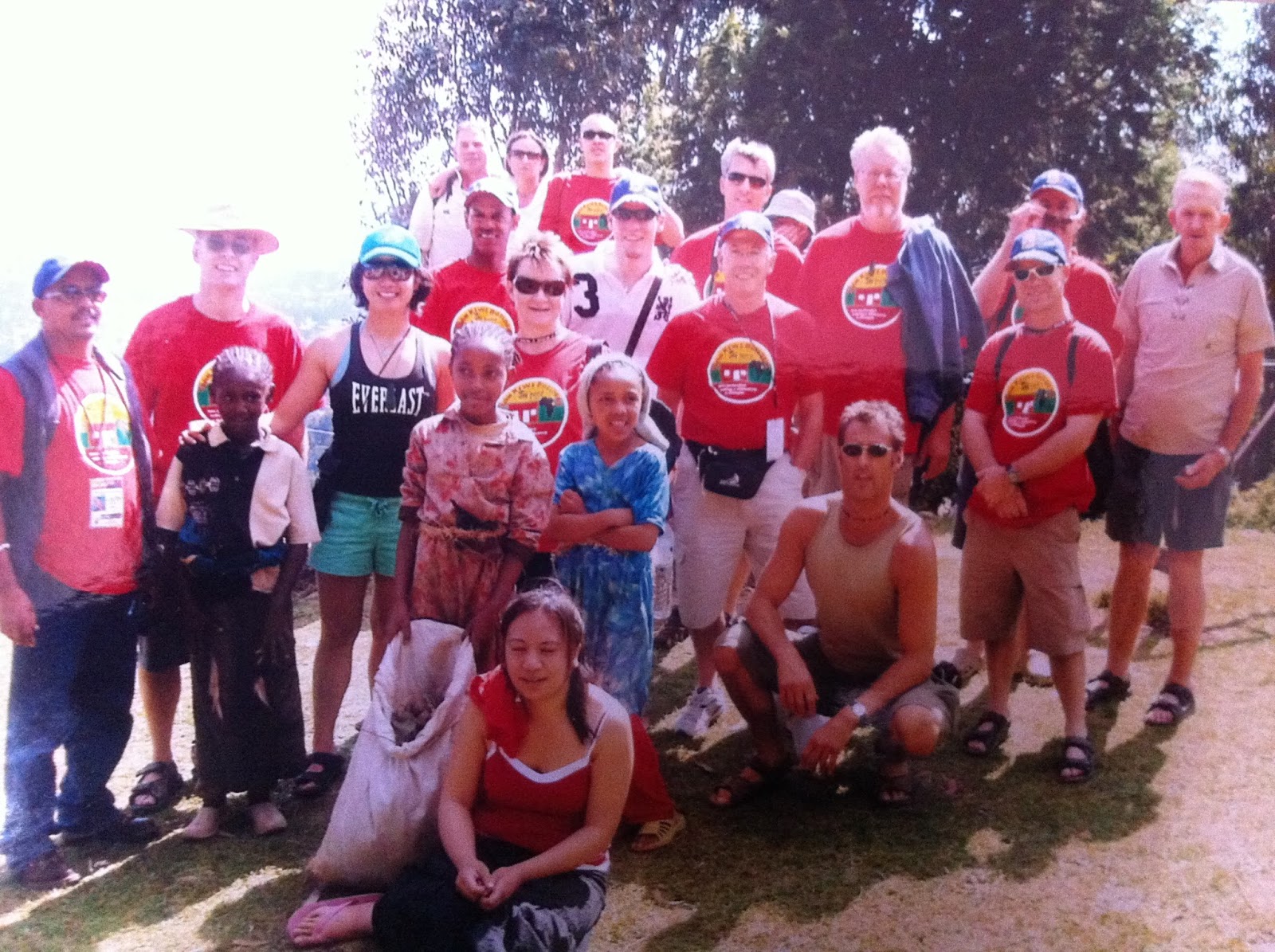 |
| Team Kiwi 2007 (and a few Ethiopian children), Habitat for Humanity Ethiopia build |
 |
| Clockwise from Left: Habitat for Humanity Ethiopia Mud house construction Jimma site; Team Kiwi member Kevin at the entrance of a house mid-construction; and me (Kim) practising my squatting skills at the bottom of a freshly dug-out to-be latrine pit. |
Under the blaring Jimma sun we work with locals (and the local village children) to construct mud houses (chika bet-oche) in various stages for two weeks. Each day we eat lunch in traditional Ethiopian fashion, with our hands, consisting of injera and various complementing food made by local women paid by us - team kiwi, and shared with all - young and old, chika bet contractors, villagers, house recipients and us - team kiwi.
Each day for morning and afternoon tea we drink traditional Ethiopian coffee (buna) freshly roasted and prepared by one of the local women. The smell is intoxicating and fills our senses with delight on a daily basis. She delicately pours from a jabena (Ethiopian clay coffee pot) into small china cups, each sweetened with sugar, ranging between 1-3 teaspoons depending on the receivers preference, usually complemented with a snack of freshly popped and sweetened popcorn or roasted barley and peanuts. Three cups of coffee are always offered at each setting.
 |
| Left: Team kiwi at the building site having a coffee break; Middle & right: Lunch time! Ethiopian chika bet constructors and Team Kiwi members tuck into lunch. |
Each day for morning and afternoon tea we drink traditional Ethiopian coffee (buna) freshly roasted and prepared by one of the local women. The smell is intoxicating and fills our senses with delight on a daily basis. She delicately pours from a jabena (Ethiopian clay coffee pot) into small china cups, each sweetened with sugar, ranging between 1-3 teaspoons depending on the receivers preference, usually complemented with a snack of freshly popped and sweetened popcorn or roasted barley and peanuts. Three cups of coffee are always offered at each setting.
 |
| Coffee Coffee Coffee!! From left to right: an Ethiopian woman pounding freshly roasted coffee in a mortar and pestle; Me in traditional Ethiopian cotton clothing on coffee serving duty; coffee poured out from a jabena. |
A captivating little village boy captures my heart. His name is Fikadu (see photo below) and my guess is he was aged about 7-8 at the time, it is hard to estimate the age of Ethiopian children with the lack of optimal nutritional sustenance factoring in many cases resulting in sizes unparalleled with their ages. Each day he finds me and assists me wherever I am working. It’s hard not to make a heart connection with at least one of the village children, they are heart tuggers.
 |
| Top from left-right: Fikadu and his brother Tamrat (Fikadu is the younger/darker one on the right); Fikadu and his family outside his house; Bottom left-right: These are the rambunctious Ethiopian children in Jimma who greet us each morning at the building site; friends |
I return to NZ changed - intrinsically, spiritually, emotionally; internally something happened. From then on my heart started to beat for this beautiful east african country.
- Second trip July-Oct 2009 (three months)
Volunteer English Teacher at English Alive Summer School in Nazret.
 |
| Collection of moments of students and teachers during my teaching season at English Alive School in Nazret in 2009. |
After spending three months volunteer english teaching at English Alive summer school in Nazret from July-Sept 2009, I return to Addis to fly back to NZ. What will turn out to be my last evening in Addis on this trip and possibly the most important day of my life.. I ride the elevator of KZ hotel on Bole road with who would be at the time - my future husband.
A well-suited up Ethiopian man and the only other occupant in the elevator, who happened to be the hotel’s manager on duty, was possibly the most handsome man I had ever seen! I couldn’t look away.. I was mesmerised. “Konjo Habesha” I said. Translation: Beautiful Ethiopian.
I have been known to lavish my appreciation of beautiful Ethiopians on them, male or female - they are all aesthetically stunning, and this time was no different from any other. A half smile was given in return and not much else. And that was that.
 |
| KZ Hotel on Bole Road |
I have been known to lavish my appreciation of beautiful Ethiopians on them, male or female - they are all aesthetically stunning, and this time was no different from any other. A half smile was given in return and not much else. And that was that.
 |
| Konjo habesha in his suit |
- Third trip - 2011-2012 (one year)
 |
| Elephant Walk Cafe on Bole Rd (exterior and interior) |
Talk about lifes' synchronocities! There are four million residents in Addis Ababa and the universe places this man in my path twice in two consecutive trips four years apart … and to top it off he still remembered my face!
 |
| Bole Road - a bustling arterial road in Addis Ababa |
 |
| From Left to right: Macchiato and Cake at Saay Pastry on Bole Road; Taitu hotel exterior; and interior |
We have a fine time enjoying pizza, listening to live Ethio-jazz music, dim yet invigorating ambiance, an impromptu ampharic lesson given by Konjo habesha under the influence of two bottles of very sweet local Axumite wine and then we head to my room for the night. And that was that.
 |
| Jazzamba vibes |
"Ambassel" by Addis Acoustic Project live at Jazzamba, Addis Ababa,
 |
| Konjo habesha |
Konjo habesha is respectful, sweet and calm. He vibes off a peaceful harmonious homeostatic energy and takes everything in his stride with a contented disposition firmly rooted in the present. A beautiful, pure, untainted soul.
 |
| Kim (me) |
I am a dream-lover, a treasure-hunter, a soul-seeker driven by visions and goals, forever blowing in the wind, changing and redirecting in rhythm with the whisperings and stirrings of my heart and soul. A wild card. Unpredictable, complicated and spontaneous. My energy rooted in ideas and possibilities - abundant and overflowing.
 |
| Yin and Yang symbol |
We are polar opposites.
Like night and day.
Like yin and yang.
Like faranje (foreigner) and habesha (Ethiopian).
Needless to say our energies clashed or balanced, however which way you looked at it, or however which way WE looked at it.
During our courtship I pushed Yonas away numerous times feeling frustrated and underwhelmed by his energy. We continued this way on and off for months, blurred lines - friends and occasional lovers. Most importantly during this time Yonas, despite our tumultuous relationship, continued to support me by coming and supporting me in my dance endeavours.
Little did I know at the time I was becoming to appreciate him emotionally. His presence, not needed but felt and cherished. His love, strong yet boldly humble, helped build a strong foundation (meseret) of friendship between us.
Little did I know at the time I was becoming to appreciate him emotionally. His presence, not needed but felt and cherished. His love, strong yet boldly humble, helped build a strong foundation (meseret) of friendship between us.
"Kass pa kass enkolal begrua tehidaletch"
Slowly slowly the egg learns to walk.
Amharic translation: things take time.
Ethiopian proverb
Click here, to follow our story of how I fell in love with konjo habesha on our trip to Jimma.


